|


« SMALL IS BEAUTIFUL » plan ACT III
A project coordinated by Alofa Tuvalu (Paris-France / Funafuti-Tuvalu)
In association with Tuvalu Ministry of Natural Ressources and Environment, Department of Home Affairs, The Fisheries Department, NBSAP, and also South Pacific Commission, IRD, SOPAC, SPREP, University of South Pacific, University of Hawaii...
Supported by The Total Foundation, CRISP/AFD
Scientific consultants : Sandrine Job, Expertise on Reef Studies, Noumea-New Caledonia ;
Coordinating Officer : Semese Alefaio, Funafuti-Tuvalu
Séverine Jacquet, Oceanology and water phd, Anglet-France and Alofa Tuvalu’s Treasurer.
ORIGINAL PROJECT DESCRIPTION
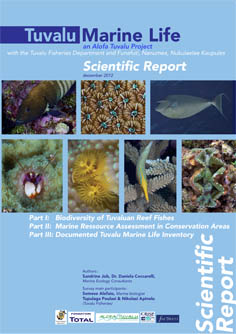
Over the preparation process, the original project and its title, “Small is Beautiful : “Climate change & biodiversity in Tuvalu : a fish documentation », evolved, into “biodiversity in Tuvalu-Marine Life” to include mammals, turtles, birds and corals as well. All pictures and data will be gathered and published into a book to become a reference to international institutions programmes as well as wide audiences. This project taking into account the scenario that the archipelago may be submerged in a few decades, aims to offer the world patrimony a unique biodiversity tool.
A. BACKGROUND
The project is part of the Alofa Tuvalu 10 year plan « Small is Beautiful » (SiB) chosen by UNESCO as one of the Remarkable Actions for the Decade of Sustainable Development. Sib’s primary objective is to help Tuvalu survive as a nation and to preserve what makes Tuvaluan culture and tradition unique.
Lost in the middle of the Pacific, Tuvalu is a nine atoll archipelago, with a total land mass of only 26 km2 scattered over 1 million km2. With a population of 11,000 people. Tuvalu is the first sovereign nation threatened with becoming totally uninhabitable within the next 50 years due to global warming related flooding. Sea level rise and rising ocean temperatures threaten fish habitats and food stocks. Tuvalu is thus facing a double threat.
Despite the threats, Tuvalu biodiversity has no definitive reference point in any of the existing documentation in the world, neither in the World Heritage Marine Programme being implementing by UNESCO, nor in the Red list of threatened species published by UICN in 2007. |
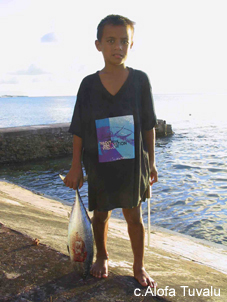 |
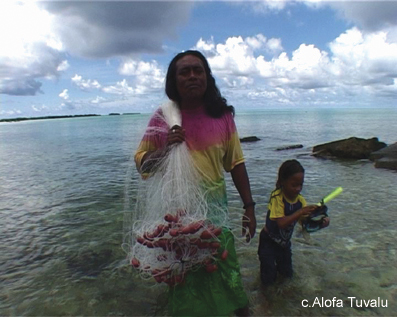
Marine resources are of paramount importance to the people of the archipelago. Land being so small and infertile, the sea is a major source of food for the Tuvaluans. Today, with traditional crops unable to grow anymore due to salt water and imported food costs skyrocketing, the issue is even more of concern.
Tuvaluan relation with their marine resources are based on centuries of tradition and an intimate knowledge of this unique marine environment. As time progresses, rapidly increasing population, new fishing boats and gears, passing away of old fishermen result in a gradual loss of local tradition. Compounded with unsustainable fish harvest from foreign vessels, there is strong un-scientific evidence that marine fish stocks declined (Tuvalu National Environment Management Strategy, 1997).
 |
B-THE PROJECT :
In this context it is vital for the Tuvaluan people to find sustainable solutions to preserve biodiversity and food security in the short term and in the longer scale to prevent both traditional knowledge and natural richness from being lost for ever.
A study (either formal/informal, written/unwritten) and documentation on the ecological knowledge of marine life is not a new area of concern in Tuvalu. The Department of Fisheries, Tango or the Conservation Office have raw datum. Several regional and international organisations also have theirs, on fish, coral or like NZAid project more specifically whales, dolphins, sharks, turtles. However, information are collated independently, data are fragmented and, for fish, studies are incomplete. |
It is in this context that this present project is being developed. Gathering existing information, helping Tango finalizing its last study, completing the survey to fill the gaps will provide an extensive inventory made of both traditional and scientific knowledge, meant to become the first published book about these topics in Tuvalu.
This project, supported by the Government of Tuvalu, is in line with the objectives of the Tuvalu Cultural Council Act (1991) encouraging government agencies, with the Tuvalu National Biodiversity Program (NBSAP), NGOs, individuals and any interested institutions to record traditional knowledge and skills.
C. OBJECTIVES & EXPECTED RESULTS :
The first objective is to create the inventory of Tuvalu unique marine life, taking global warming into consideration paying special attention to endemic species and including fishing methods, calendar, tide and spawning sites..
Locally :
- Education and knowledge : help Tuvaluan communities to preserve their lagoon and
coastal marine life
- Addressing needs of people and securing food supply;
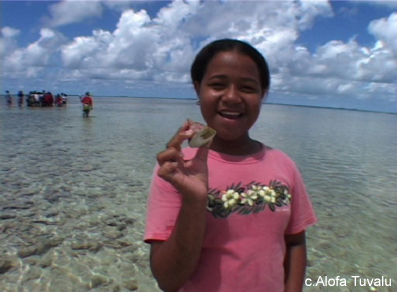
- Conserving culture heritage; sustaining cultural identity; protecting Tuvalu’s indigenous diversity. |
 |
Globally :
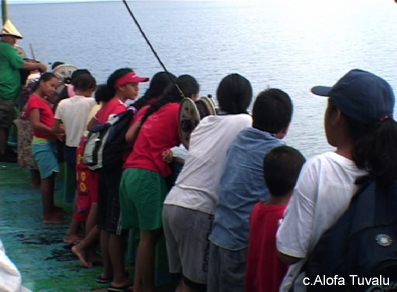
- Providing reference publications for local, regional and worldwide release based on scientific monitoring techniques to provide a baseline for future monitoring.
- have the results referenced in the World Heritage Marine Programme from UNESCO and other international and lists directed by institutions and NGO such as UICN.
- become the foundation of future evaluation for surveys on global warming effects and consequences over the next decades.
 |
C. METHODOLOGY :
Rather than reinventing the wheel and start yet another study, we opted to federate past and current projects into a national book inventory as exhaustive as possible.
Without partner’s data, pictures and know how, this book project simply cant happen.
By definition, the different projects were and are implemented each with their own scientific methods, most of them internationally recognized. Data have been and will be gathered by ocean and marine resource specialists and scientists, such as Clinton Duffy (NZ Aid), Sandrine Job (Crisp), in collaboration with local specialists such as Semese Alfeaio, the department of environment, the kaupule, the fisheries etc. |
Datas and articles will be published by each of the authors in scientific publications (of which to our knowledge there’s none yet on biodiversity in Tuvalu). All data will be compiled by a team including Severine Jaquet (Alofa Tuvalu). Once consolidated, what is left to be studied will appear obvious. We will focus on 4 islands (Nanumea, the closest to the Equator), the most southern island, Niulakita, one central island (Nui, Nukufetau or Vaitupu) and the main island, Funafuti.
Pre publication works will include gathering elements and working on pictures and other elements such as articles by the partner’s teams and scientists, forewords etc, graphism, laying out the book.
The book will be a A4 format with a hard cover on 500 pages displaying around 1000 pictures (small format for most) and many tuvaluans and scientists points of views or tales. Printing is done on recycled paper with organic inks. Other leaflets and communication tools can be produced from the book in order to disseminate even further the know how among the Tuvaluan population and beyond.
D. PROJECT DURATION : Original project started in 2006. Objective is to release the book in around 2 years from now. To optimize the communication, Tuvalu being already recognized as a symbol of climate change, the release would be linked to an Unfccc international event about global warming.
E. COMMUNICATION
If, as a consequence of global warming, the nation of Tuvalu had to leave its land and waters, this Tuvaluan Fish Documentation would become a unique tool and a priceless remembrance book for Tuvaluan culture and tradition as well as a useful tool for public and scientists around the world. Being part of this unique biodiversity tool and reference could definitely become a great communication tool for all stakeholders and partners and before all : Tuvalu.

Our biogas awareness campaign started with women communities as early as 2005… After the implementation of the pilot biogas digester in Amatuku (2006-2010) and trainings sessions, several requests for reproduction came from the outer islands. Alofa Tuvalu was offered by Taukiei Kitara and Semese Alefaio (then Tango's officers) to participate in the UNDP Small Grants Projects for a reproduction in one of the northern islands.







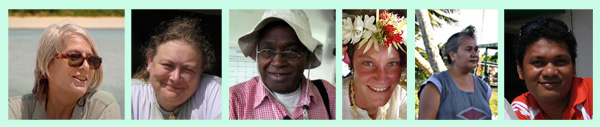
A core team is set up: AT President Gilliane Le Gallic and AT Biomass specialist Sarah Hemstock are the project general managers, AT Biogas specialist Sikeli Raisuqe provides consultancy, equipment design, purchase and training, Fanny Héros is Project production assistant. Later on, once the choice of island is made, Teuelu Manuella joins the team as the local project coordinator and Kaio Tiira Taula acts as the project facilitator.
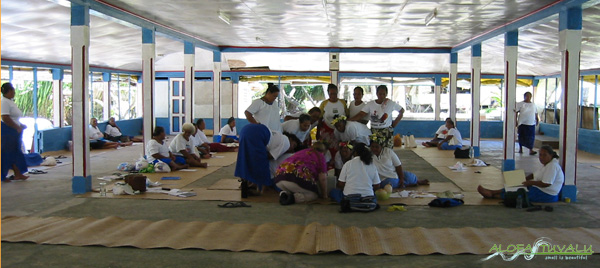
A first survey and communities meetings trip took place in May 2009 in Nuitao, Nanumanga, Nanumea. The team opted for Nanumea, the furthest island to the North…
 In April 2010, Alofa Tuvalu biomass specialist Sarah Hemstock held another Nanumea community meeting and decision was made to use plastic digesters rather than a brick Chinese dome. After several months of research for such equipment from India to China to Sweden, at first, a unit from a UK plastic manufacturer was ordered. Cost of shipping was so high that we had to find a better alternative In April 2010, Alofa Tuvalu biomass specialist Sarah Hemstock held another Nanumea community meeting and decision was made to use plastic digesters rather than a brick Chinese dome. After several months of research for such equipment from India to China to Sweden, at first, a unit from a UK plastic manufacturer was ordered. Cost of shipping was so high that we had to find a better alternative
Nanumea islands' isolation has a serious impact on transportation and duration of activities. If we had kind of taken into consideration possible local disturbance in cargo shipments and possible political turmoil in the region or the country, we could not imagine that an Iceland Volcano would erupt stranding all flights in and to the Pacific for a while.
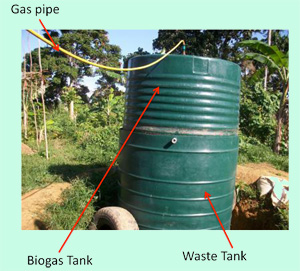 It was decided to try to have the unit manufactured regionally to ease future reproductions in Tuvalu. It was decided to try to have the unit manufactured regionally to ease future reproductions in Tuvalu.
Alofa Tuvalu President Gilliane Le Gallic met with our biogas specialist Sikeli Raisuqe in June 2010 and handed him photographs, sketches and information gathered on existing plastic units. Sikeli managed to build a prototype and tested it for several weeks to make sure it would comply with the quality and relevance criteria issued.
Equipment (4 digesters, wood and concrete for piggeries, chicken wire for the gardens) was ordered in Fiji, in July and in August and September 2010, Sikeli and Sarah went back to Funafuti and Nanumea with most of the equipment. Some got lost.

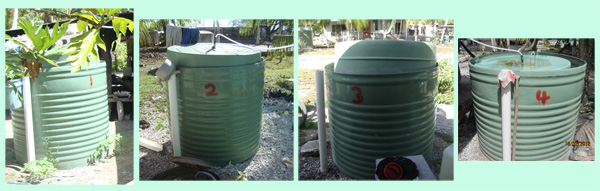
Despite the changes of parameters and the fact that we were in the midst of national elections, almost all of the equipment was transferred to Nanumea in due time, and 4 digesters were implemented instead of 1 originally planned. A first set of training happened with the families where a digester was installed, their neighbors and island authorities. A local team was set up and Teuleala Manuela chosen as the local project coordinator. The overseas team and the regional team kept in regular contacts.


- August 28 - sorting out the boat cargo in Funafuti, an inevitable saga
- September 3 – project team & equipment reached destination
- September 7 – meetings with Kaupule and women + one digester fixed up
"(We) had a big Kaupule meeting yesterday - 59 in attendence, but only 3 women - womens meeting tomorrow. 1 digester has already been fixed up & has some shite in it already.... So we are well on schedule. 4 families are taking part and it is good that they are all enthusiastic at this stage!"
- September 10 - all units installed and last community workshop, by Sarah
"All units are now installed, had last of the workshops this morning but community worker.
I have left seeds with Sinati & Kaupule gardener to distribute."
- September 14, 2010 - concluding remarks by Sikeli and Sarah
"We have constructed 4 biodigester units at Namumea and also conducted a workshop for the 4 who will be running the project. They will be collecting waste from around the area to feed the digester it will take them 1hour to collect 10kg of waste then take it to the bio tank. They did not have a concrete piggery for easy collection of waste but they were told the importance of building one. Best regards, Sikeli"
"… we arrived back safely from Nanumea yesterday … The community were great and kaupule support was brilliant, so I just hope that the people who have been selected by the kaupule see things through. I have collected some provisional figures for cement and small equipment… Cheers, Sarah"
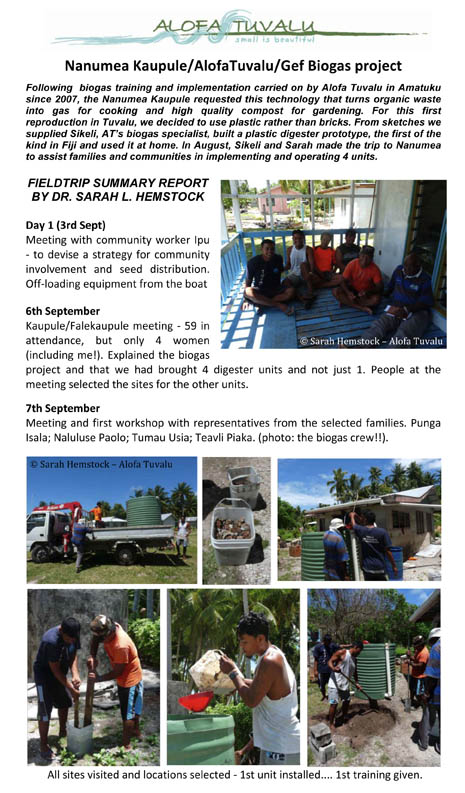

Teu's report indicated that small problems needed to be fixed. Amongst them :
- During the long drought from September 2010 to April 2011, water was rationed and "the families in the project cannot spare some water to fill up the unit with manure".
Missing equipment was hunted for and found. Water tanks were ordered along with additional equipment:
- Stronger stoves: current ones would not lit anymore
- Bigger funnels to fill the manure into the digester and other small fittings and accessories.
2 more trips would prove necessary for fixing and training but activity was suspended for over a year, waiting for the 2nd GEF/UNDP installment confirmation. A stumbling block was related to changes in budget lines… The plastic option cost less in transportation and building team than planned. However, duration was twice as long as budgeted from 1st community meetings in 2009: one year preparation instead of 5 months. Before implementation, 2 trips were necessary instead of 1. Tests, implementation and first training also meant complementary purchases and time. It is to be noted that overseas consultants's fees are based on local low rates. Most of the overseas wages are inkind.
After months of silence from UNDP, discussions started again and eligible expenses were revised within the global budget. An amended MoU rescheduling activities and disbursements was finally signed in September 2011.
After such delays, despite our fears not to receive the money in time, in October 2011, Alofa Tuvalu advanced more funds for Sikeli's tickets and the new equipment purchase.
Early November 2011: the instalment planned in April 2010 is finally credited to our account. A relief.
The project can resume, but delays led to significant changes in the project's team:
Isala, one of the beneficiaries, passed away. Change of digester's site was put under kaupule's decision (local town council).
After having worked over a year, in September 2011 when Alofa Tuvalu sent the signed amended MoU, local project coordinator, Teu, writes she can no longer follow up the project… Contact person for the project at the Nanumea Kaupule, Sipele, does not reply emails, then leaves the country.
At this stage, a new onsite mission was of paramount importance to rekindle motivation and trust for the sustainability of the project.

AT President Gilliane made the trip late November 2011. AT biogas specialist Sikeli made himself available for onsite mission in Jan/Feb 2012. Meanwhile, project manager Sarah, moves to Fiji, a reassuring perspective for the project sustainability…


- Meetings with concerned individuals:
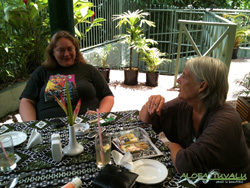 - In Fiji : Two preparation meetings are held with Gilliane, Sikeli and Sarah. - In Fiji : Two preparation meetings are held with Gilliane, Sikeli and Sarah.
- In Funafuti :
*Baton passing meeting with former project coordinator Teu.
*Meeting with the new kaupule planner, Puatei Tevesi, as the Nanumea Kaupule representative for the project : awareness workshop feasability and costs, equipment's transport from Funafuti to Nanumea, team accommodations…
*Recruting and briefings local project facilitator Kaio Tiira Taula: he will be assisting AT biogas specialist with translations from Fijian to Tuvaluan, arranging logistics, taking pictures and assisting in reporting to AT.
- Equipment shipping… a whole saga and AT crew members' trip setting up
AT Vice President Eti warns: "Nivaga 2 in Suva for drydocking will departs towards mid November. Manu Folau will be in Suva towards end of January 2012, but no building material can be loaded." The Nivaga 2 option is chosen…
December 4th 2011, the boat is still on dry dock. To avoid waiting for the Nivaga hypothetical departure, decision is made to try to upload equipment on the Manu Folau. Secretary to Government Panapasi Nelesone, Marine and Transports departments exchange emails with freight agent and captain. According to all concerned it should not be a problem for the captain "to hand carry (the goods) over". In addition, Manu Folau going to Nanumea immediately after Funafuti, there would be no need to download and upload the equipment again.
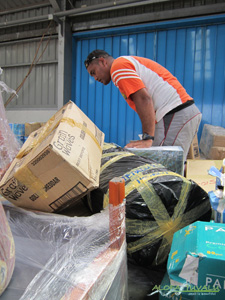 Unfortunately, Manu Folau is full. Sikeli confirms on december 12th, that our cargo was left at the wharf and will come on the Nivaga… The equipment will have to be unloaded at the Funafuti warf and loaded on the boat to Nanumea. December 15th, Sikeli confirms equipment's shipping, arrival scheduled on December 19th. Unfortunately, Manu Folau is full. Sikeli confirms on december 12th, that our cargo was left at the wharf and will come on the Nivaga… The equipment will have to be unloaded at the Funafuti warf and loaded on the boat to Nanumea. December 15th, Sikeli confirms equipment's shipping, arrival scheduled on December 19th.
Localizing the equipment and getting it out of custom during Christmas and new year's weeks turned into another saga involving many trips from the warf to downtown (marine and customs offices).
Thanks to a collective effort (AT members' team, Kaupule planner, Custom officers, Nito chief of cabin and other Nivaga crew members), water tanks are located at the warf, and fittings and accessories were found in one room at the very bottom of the Nivaga.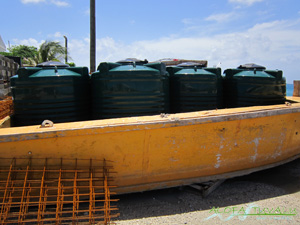
Equipment is expected to leave with the Kaupule planner on the Jan 10th boat when the AT biogas team is planned to leave for Nanumea on the Jan 17th boat.
 Strong winds preventing boats from navigating the 10th trip is postponed. Strong winds preventing boats from navigating the 10th trip is postponed.
On January 12th when Sikeli lands in Funafuti, the boat is confirmed to depart the day after. Given the unpredictibility of transportations, it is decided to advance the team's departure by one week and jump on that vessel. The kaupule planner travels on the same boat, same goes with equipment.
The most reasonable decision puts everyone into a rush with one day instead of a whole week to arrange AT crew members' trip…: to buy the few goods left to purchase, change boat tickets, sort out lodging, food and local expenses, provide the guys with enough cash, including for setting up workshops etc. ; Mission objectives and relative activities are confirmed ; A "Biogas for outerislands preliminary notes" is amended by Gilliane and Sikeli for him to leave with copies for project participants, kaupule and local dissemination ; AT 2010 King Tides Festival videos are copied for screenings…
 The boys left on January 13rd, as planned. Mission objectives were: rekindle interest, re-explain the project to new kaupule's officers, making sure the four digesters are working to satisfaction, setting up one water tank at each owners' place, build individual piggeries if proven relevant, setting up the basis for gardens, training owners and workers as well as raising awareness among the Island inhabitants by setting up workshops on technology… This section is made of extracts from Sarah Hemstock final report to UNDP on behalf of Alofa Tuvalu comprising daily reports and blogs provided by Sikeli and Kaio. We added here and there infos, quotations and what we thought could be of use to a general audience. The boys left on January 13rd, as planned. Mission objectives were: rekindle interest, re-explain the project to new kaupule's officers, making sure the four digesters are working to satisfaction, setting up one water tank at each owners' place, build individual piggeries if proven relevant, setting up the basis for gardens, training owners and workers as well as raising awareness among the Island inhabitants by setting up workshops on technology… This section is made of extracts from Sarah Hemstock final report to UNDP on behalf of Alofa Tuvalu comprising daily reports and blogs provided by Sikeli and Kaio. We added here and there infos, quotations and what we thought could be of use to a general audience.
- MOU and visits at promoters to rekindle motivation and fix problems raised
 Good news is that despite the issues 3 of the 4 digesters were producing gas. Good news is that despite the issues 3 of the 4 digesters were producing gas.
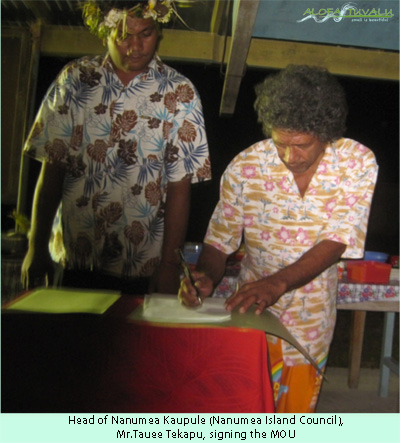
Upon arrival project facilitator Kaio and the Kaupule visited the 4 households with digesters, including the new family who replaced the owner that had passed away. After 3 meetings & several exchanges with AT regional and overseas management team, a MoU (English/Tuvaluan) is drafted and signed in between AT, the digesters owners and the Nanumea Kaupule acting as project monitoring committee.
A Biogas promoters meeting was held on January, 16th. Kaio wrote: "worked with the bio-Gas promoters today... good news is that the digestors are producing gas.... go Nanumea go... be the first island in Tuvalu to use BioGas..."and two days later "We have been excited to experience the first family to use Bio-Gas in Tuvalu..."
The issues fixed:
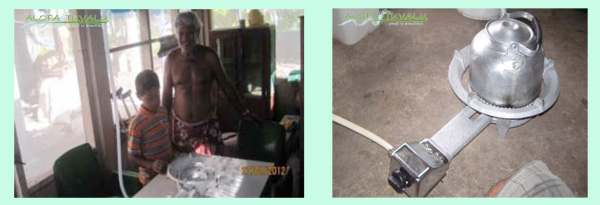
- The original stoves did not last long in the corrosive tropical climate of Nanumea. New stoves of a more robust design were installed.
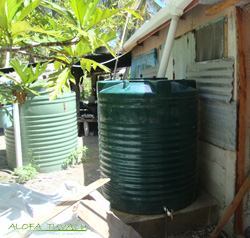 - The 2011 drought put stress on fresh water availability across all Tuvalu islands. Tanks for water collection to use in the digesters and clean and water pigs were delivered to the respective families with digesters and installed on hard stands as planned. One of the families was using the digestate to water their breadfruit and coconut trees. Some minor adjustment had to be done on one of the digesters: the digestate was not going out of the outlet pipe. Hopefully, the increased water storage capacity will alleviate the impact of future droughts on the use of biogas digesters. - The 2011 drought put stress on fresh water availability across all Tuvalu islands. Tanks for water collection to use in the digesters and clean and water pigs were delivered to the respective families with digesters and installed on hard stands as planned. One of the families was using the digestate to water their breadfruit and coconut trees. Some minor adjustment had to be done on one of the digesters: the digestate was not going out of the outlet pipe. Hopefully, the increased water storage capacity will alleviate the impact of future droughts on the use of biogas digesters.
- The problems caused by pigs running loose around Nanumea had been raised earlier by the community. The building of pigpens by the families with digesters had been agreed. However when the team arrived, only 1 pigpen had been built. The team realized that some materials was stuck in Funafuti since September 2010. Put on the boat to Nanumea without anyone being warned, it came back undelivered to Funafuti… It finally found its way to the Island and the construction of 3 pigpens was completed in February 2012.
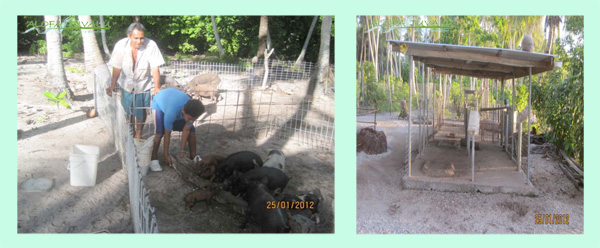
One to one discussions and trouble-shooting sessions were held with all the plant owners to discuss various problems encountered. These sessions covered all subjects from digester functioning to piggery problems.
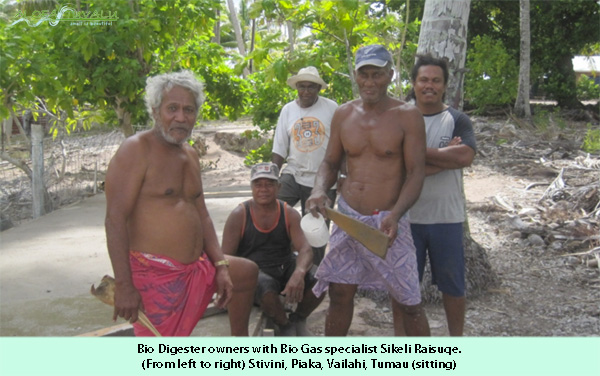
As a result of these one-to-one sessions Sikeli wrote on the AT Blog:
"As for the pig waste collected from around the island it is very dry because pigs are taking in less water and also the climate condition here seldom go below 30°c. They were told to collect pig waste and then soak the waste over night (in FRESH water) to soften the waste before it is poured into the digester.
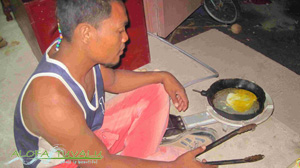 The three digesters are still working and Steven is very happy with his plant because now his family is able to use the gas to cook tea every morning... The two grandsons staying with him are the ones feeding the digester and also looking after the pigs. The three digesters are still working and Steven is very happy with his plant because now his family is able to use the gas to cook tea every morning... The two grandsons staying with him are the ones feeding the digester and also looking after the pigs.
Steven's water tanks has been installed next to the bio digester by the kitchen using the roofing iron from the kitchen… (he) scarifies one 6x1 timber on his walls of the house to be used as facer board.
Teauli, one of the boys who work with us, was the one who did all the plumbing work on the guttering he modified material so we could have water flowing into the tank... The five men who assist us with all the work are Malosa, Dusty, Kausaga, Teauli and Taumaeke."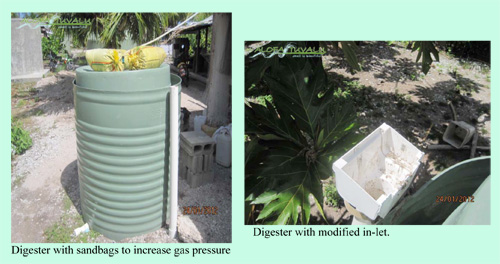
When Kaio made his last trip in March 2012, all 4 digesters were operational and being used by the families.
4 family vegetable gardens were set up on land belonging to each of the families. They were fenced off using locally available materials such as coconut leaves until mid March when the Kaupule distributed the chicken wire purchased by Alofa Tuvalu for this purpose… Lost and found back…
- Training on preparation, construction, operation & maintenance for community promoters and community
Promoters' training is an ongoing activity all along the project implementation.
On January 31st, 1 biogas training workshop with promoters was held. Sikeli wrote: "The workshop was ok on waste management for Bio gas with about 80 people attending (30+ women) not counting people standing outside of the Maniyapa peeping in. The church minister of Nanumea open the workshop with a prayer and all went well and a nice refreshment prepared by the women group. There was some discussion on their pig damaging vegetation on the island and polluting underwater well." Training Materials used: Alofa Tuvalu Biogas DVD (Take a look at Alofa Tuvalu you tube channel).
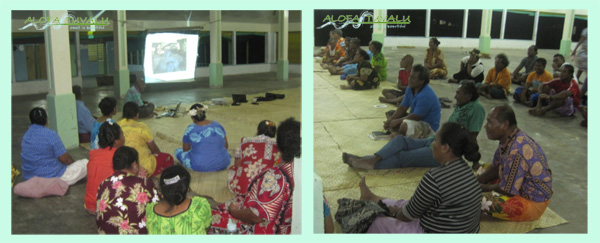
On February 6th, Kaio and Sikeli ran a community workshop on pig management at the request of the Kaupule and as a response to issues raised by the community. All issues concerning husbandry – including disease transfer to humans – was covered. Health Centre personnel attended this workshop and were very interested in the human health aspects of pig management. A demonstration was given on teeth clipping and castration for people on the island to follow and learn from. 100+ people attended this event.
The project team organized 12+ digester site visits with selected families.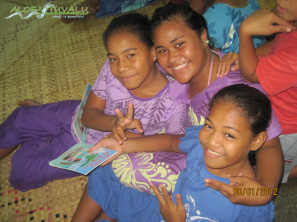
Additional awareness activities:
- A cassava planting demonstration for family garden where digester is located.
- Awareness program at the Nanumea school and distribution of the Tuvaluan version of "Our planet under Water" comic books
- Alofa Tuvalu King Tides Festival video screenings

 Sikeli (February, 2012) – "The Kaupule staffs prepared a big parting dinner for us and Ruru on the same night as the sighing of the MOU. All bio plant owners (were) present during the ceremony with the exception of Steven who did not attend because he was sick. The papers were taken to him the next morning. Sikeli (February, 2012) – "The Kaupule staffs prepared a big parting dinner for us and Ruru on the same night as the sighing of the MOU. All bio plant owners (were) present during the ceremony with the exception of Steven who did not attend because he was sick. The papers were taken to him the next morning.
The chief of the Kaupule - Taue - signed the documents for the administrator of the island and we had to perform an impromptu dancing act Fijian style as the custom of the island dictate. The three bio pant owners now enjoy the use of pig waste to form biogas for cooking."
Mid-March 2012, when Kaio returned – all 4 digesters were producing gas.
He wrote "I think the Nanumea Bio-Gas project is a success and it will be successful on the long run."
 In Alofa Tuvalu final report to UNDP, Sarah concludes : In Alofa Tuvalu final report to UNDP, Sarah concludes :
"Following on Community & stakeholder consultation and selection of designs for digester & pig housing the implementation of the digesters has proved highly successful. Additionally, pig housings being built will ensure effective collection of pig waste for the digesters. This will, in turn, guarantee that the waste does not enter the environment and will, in fact, provide an excellent fertilizer for family gardens. At this stage, no additional technical assistance is required.
AT Team is delighted with the enthusiastic way in which the Nanumea community members involved themselves in the project activities. Kaupule project management is working well since the January 2012 update. We would like to thank the Nanumea community and the Kaupule for their help, generosity and support in successfully completing this stage of the project.
The kaupule garden growing organic seeds from Alofa Tuvalu is progressing well and is still growing egg plant, tomato and chilies from the 2010 mission.
We all had thought that a design should be drafted for the digesters to be manufactured at the Rotamold facility in Funafuti which currently makes high quality plastic water tanks. Additionally – in August 2012 – it was suggested that the project could also be expanded by training people to make tanks from fiberglass. This would allow small business set-up (re fiberglass fabrication for boat repair and tank construction). The project can be more easily replicated in the other outer islands. Since manufacturing would be in Tuvalu, several jobs could be created for local people. Spare parts and repairs, as well as construction, could be facilitated within Tuvalu, future biogas digesters would be more easily available and the project be sustainable over the long term.
In addition, the Kaupule is considering how to expand the project in the future.
And the Nanumea community requested that a pigpen and digester be built on the islet of Lakena."
Since then "seeds planting news" speak for themselves...
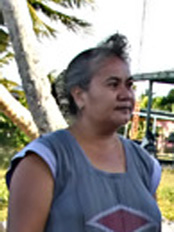 In October 2012, Teu wrote : In October 2012, Teu wrote :
"Gill and Fanny talofa,
…. I have to let you know that I am now working for Sara from USP as the In-Country Coordinator for Tuvalu for one year contract. This is my third day at work!!! Thank you for getting me on board Alofa Tuvalu and get the glimpse of our vulnerability to cc and I know the experience with Alofa Tuvalu gives much support for this appointment of mine. My great thanks for the good work for our people!!!
I also like to inform you that I have been asked by the Ministry of Home Affairs to write a case study on the Biogas Project in Tuvalu. I am going to make my topic as "Community Participation in Biogas Production in Tuvalu". I know Sara is up to her neck with her work and I don't have the heart to add more burden to her. I just need the Aim and Objective of the Project and if possible can you get me two or three photos during the construction of the unit at Amatuku and probably on Nanumea as well. I have the latest pictures of the units at Nanumea and tell you it is appreciated so much by the four families that are using the units, especially the elderly couple who used it at daily basis. The Planner of the Kaupule on Nanumea informed me that this couple maintained the production of gas by filling two buckets of manure a week so that is not much work for them. Thank you so much on this. I will attach this for your information (I have difficulty in sending you but will get someone to send it for me).
I need to send this report this week if it is possible with you two"
….
In November 2012,- Sarah Hemstock, Alofa Tuvalu biomass is back in Tuvalu specialist as project team leader at USP Fiji and assists Teu out with a National Adaptation Workshop about biogas… She writes: "Tuvaluan's are delivering the messages (its 9pm, we have been going since 9am and there are still over 60 people here!)… and we have brought people in from communities on outer islands as they are the ones who will be implementing the activities we will be developing under this project... Alofa Tuvalu is very much in everyone's minds!!"
… "Alofa Tuvalu has really planted seeds – there are now 2 plans like we spoke of: 1 for an energy efficiency house and another for an "eco-house"… As well as the big national renewable energy plan…"
…"We can fund more digesters. I think that this would run more smoothly now... The folk from Nanumea have asked for more digesters at the workshop we just had - which was great - and one guy from the community in Nanumea also presented his experience with the project which was fantastic!!"
Last but not least from July 8 to 12, 2013 former project coordinator Teu and project manager Sarah are key speakers at the 12th Pacific Science Inter-congress "Science for Human Security & Sustainable Development in the Pacific Islands & Rim", USP Fiji. Semese Alefaio, marine biologist, a key participant in the Tuvalu Marine Life project and an historic member of Alofa Tuvalu writes "I am currently attending the Pacific Science Inter-congress in Suva. Sarah, Teu, Mataio, Luke and Vili are also here at the meeting and we really appreciated the tremendous effort that was put up by Alofa Tuvalu for Climate Change in Tuvalu. It was highlighted in many presentation at this meeting. Bravo! Fakafetai lasi, manuia te aso! Sem"
In August 2013, Sarah wrote:
"Seed sewing news" is that more digesters are right now being implemented in Nanumanga selected as one of the 3 most vulnerable in Tv and the community members themselves decided to reproduce what had been achieved in Nanumea re the biogas... We are installing 7 units with the Kaupule. Kaio, Sikeli and Teu are the Tuvalu crew and they are physically doing the whole thing... I am just channeling funds and reporting... So this is real empowerment of communities and sustainability of AlofaTs legacy!",

All along the 3 years that the Nanumea biogas project lasted, numerous communication materials and events (websites; newsletters, meeting presentations, radio, etc.) were used locally and internationally.
Below are a few examples:
In Tuvalu : Awareness started in 2005 with regular meetings, workshops, daily radio programs… Here is a few examples from 2010.
Early 2010, the first Tuvalu King Tides Festival, and more specifically the Ka Lofia Te Paneta Event, was an opportunity for Tuvaluan children, teachers and parents to discover the biomass technologies available in Tuvalu. The TMTI engineers displayed pictures and video about Biogas and replied many questions.
From February to June 2010, Radio news, interviews and announcements were aired about the project.
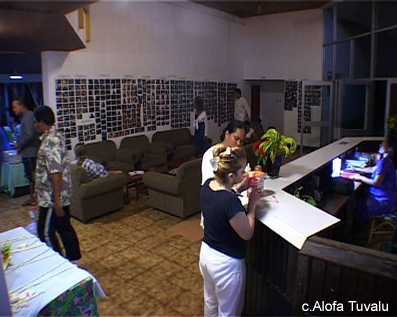
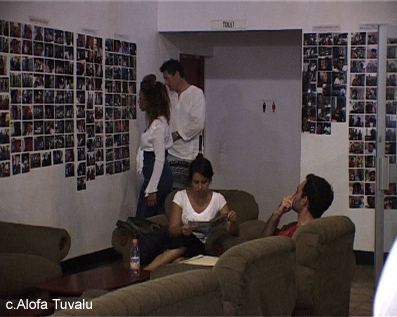
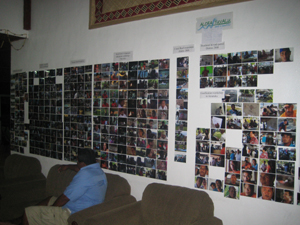
From May 17th 2010, Alofa Tuvalu ran its traditional pictures exhibition at Vaiaku Lagi hotel with about a thousand pictures, including biogas. The exhibition lasted a month.
The same month, taking advantage of the presence of a Tuvalu Radio journalist on Nanumea, Teuleala organized a "live" report about the digesters.
From January 10th to 19th, 2012 : picture exhibition is run again at the Vaiaku Lagi Hotel (photo avec sikeli devant biogas)
In February & March 2012 Tuvalu radio updated audience on the project with a press release and interviews of Kaio and Sikeli
April 4th, 2012 : Workshop by Kaio with seafarers and trainees (Funafuti – Tuvalu, on board Nivaga).
AT members in Funafuti, such as Lee/Faiva Moresi, kept promoting the technology to all TMTI visitors, Tuvaluans and palagis alike.
November 12th, 2012, Teu and biogas in Nanumea projects' promoters are key speakers at a National Adaptation Workshop gathering institutions in Funafuti. This lead to the second reproduction project at the request of the Nanumanga community!
In Fiji:
Sarah is invited to speak at the "International Conference on Renewable Energy & Climate Change" in October 2010. Rather than creating more gas emissions by doing the trip, it was decided that Sikeli would make the presentation from a PowerPoint supplied by Sarah.
In Tahiti:
From August 2nd to 6th, 2010: Melton Tauetia, Alofa General Secretary, presented Climate Change in Tuvalu at the XXII congress of communes taking place in Punaauia (Tahiti)
In Europe, since 2007, biogas is being promoted to children and adults audiences, based on the Amatuku and Nanumea projects.
In France:
In between 2009 to 2012, 30+ conferences about climate change impacts and solutions for adults and children were held in different French cities or territory such as Martinique.
In addition, biogas was specifically promoted at the following events:
December 7th, 2010: "Environment on Tuesdays", about AT 2010 activities in Tuvalu with pictures about September implementations and "Ka lofia Te Paneta" exclusive footage.
March 26th, 2011 : Conference focusing on climate migrations with a screening of the France 5 documentary "Paradis en sursis" promoting Alofa Tuvalu activities in Tuvalu, at the National "Cité for Immigration" (Paris).
En 2012, 2 photo exhibitions about renewable energy and biogas were specifically designed for children.
At the French Yeu Island, a screening and debate with the audience focused on biogas benefits for islanders.
In Belgium:
- October 4th, 2011 : Gilliane is a keyspeaker at the "Climate Migrants" seminar in Brussels
In Germany:
- From June 5 to 11, 2010: Alofa Tuvalu, member of the Tuvalu delegation, is the country booth keeper at the Bonn Climate Talks promoting the country's efforts to reach "the fossil fuel independency by 2020" target.
- From November 19th to 21st, 2010: "European and Pacific Responses to climate change in the Pacific" conference in Berlin.
In the UK:
From October 9th to 20th, the "We are all Tuvalu", an exhibition put together by Sarah and artists, gathered several hundreds children and their parents.
From 21 December 2010 – 7th January 2011 : "Biomass" exhibition by Sarah at the Refectory Gallery, Nottingham City Artists, Hooton Street, Nottingham.
May 4th, 2011: Exhibit about Tuvalu and AT's small is beautiful plan by and with Sarah Hemstock at Notts Trent Uni Environment & Sustainability Research Network Exhibition, DICE Centre Conference Suite, City Campus.
About 150 press articles were published about Alofa Tuvalu activities in between 2009 and 2012 all of them encouraging people to know more and to visit our website.
Newsletters describing the activities were sent to the Tuvaluan people and AT contacts in the Pacific and elsewhere in the world.
Newsletter_fall2010.pdf
Newsletter2011_extracts.pdf
Newsletter_dec2011.pdf
Newsletter_feb2012.pdf
Alofa Tuvalu BLOG and website is updated in French and English with news about the Nanumea project since 2009.

CONTEXT
Small Is Beautiful, a decade long plan, started in 2004 has for primary objective to assist the Tuvaluans to survive as a nation, and if possible, to allow them to remain on their ancestral land. Tuvalu is symbolic on many levels. The idea is to start from this tiny example to develop a program of constructive action – one which is replicable and likely to garner the necessary media attention. Tuvalu, a tiny and extremely low-lying nation, is the epitome of vulnerability. It is also, due to its small size, recent habits of consumption, and traditional relationship with nature, a perfect candidate for becoming the first country to operate in harmony with the environment, an environmental showcase of the earth, a living ideal for the planet to emulate.
A media campaign based on a positive, unifying and concrete program: assisting Tuvalu, as its own destruction approaches, to become an environmental showcase - a living, breathing, replicable model of an environmentally respectful and exemplary nation - is a compelling means for Tuvalu to leave both a vital message and an important legacy to the world.
To help Tuvalu become a model of an environmentally respectful nation means working and coordinating with each of the main areas of sustainable development in harmony with the local ecosystem and natural resources : Energy, Water (drinking and waste water), Waste, Atmospheric emissions, Erosion and Biodiversity, which may have also positive consequences on food quality and human health.
The first step of the program consisted of obtaining Tuvalu’s people and government participation and support for the project. It coincided with a request from the Tuvalu government to the French foreign affairs for assistance on Renewable Energy.
The second step is a Renewable Energy preliminary study which started, with a 6 week field trip, in 2005, by Sarah Hemstock and Pierre Radanne.
The third step is to create an environmental and training micro-model for renewable energy on Amatuku.
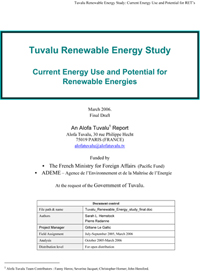 THE STUDY THE STUDY
This Tuvalu renewable energy study is probably the most thorough report on the subject made in the region. Hundreds of studies and government finance data, 20 years of agricultural reports and 50 years of wind measurements were analyzed and over 100 people consulted. If the study has yet to be finalized by Sarah Hemstock and Pierre Radanne, some of the main conclusions and recommendations can be summarized.



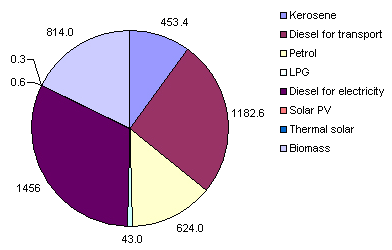
Tuvalu is close to a 100% oil economy
The primary energy consumption represents the upstream supply (Fig. 2). The only national source is firewood at around 18% based on our 2005 study (photovoltaic and thermal solar are insignificant). The balance of supply is oil. The high level of oil imports dependency mainly for the transportation sector and electricity generation greatly demonstrates Tuvalu specificity. The level of consumption stems from the high needs for sea transport which represents around 40% of the total use. Energy needs in Tuvalu have increased since the construction of the new hospital in 2003 offered by Japan, and the government building in 2004, a gift from Taiwan. A Japanese team is presently implementing 3 new fuel generators. Production will exceed the needs and will go against Kyoto’s directives, who’s goal is to reduce global warming gas emissions before 2012.
This situation is now more worrisome than ever as the world is facing a new oil crisis. Prices will drastically increase in the next decades. If the whole world will have to cope with this, the small pacific islands will be faced with an even greater problem.
Renewable Energy is under used
If Tuvalu was a pioneer in photovoltaic (PV) solar energy more than 20 years ago, lack of maintenance and management failure have today made PV use insignificant.
Potential of other locally available renewable resources such as wind, biofuel (coconut oil biodiesel) or biogas is not exploited at all yet in Tuvalu and not much elsewhere in the Pacific.
Other indigenous resources, such as copra and organic waste are very much under used. Copra production which was developed for export purposes collapsed. Mainly due to distances, Tuvalu’s production is not competitive.
Other topics
Concerning municipal solid waste : apart from aluminium cans which are compacted and shipped to New Zealand, all imported waste stays on site. 70% of the waste volume is organic.
Due to sea water contaminated soil, taro’s culture has been replaced by imported food.
Rain water is the only source of drinking water. Water tanks are multiplying but not everyone is able to buy them. Only 64% of the population is boiling the water before drinking. 40% use firewood, the remaining 60% comes from oil. The only desalinisation plant, on Funafuti, is often out of order.
Waste water is hardly taken care of. Drainage work is rudimentary. Very recently, the presence of smelly seaweeds in the lagoon could mean that the marine eco-system is already contaminated.
To help Tuvalu to become more oil independent by developing in priority biomass energies using waste for biogas and coconut for providing biodiesel for ships.
To carry out additional wind measurement to better evaluate Tuvalu’s wind power potential.
To consolidate existing solar installations to optimize the network.
In the past, a number of projects initiated in the Pacific and other small or isolated communities, ultimately failed due to lack of effective training and maintenance follow-through. To avoid past pitfalls, it is recommended to create, a hands-on experience and micro RET’s “showroom”/training center for the Tuvaluans…and an effective, practical 1st step on the way to an expanded national program.
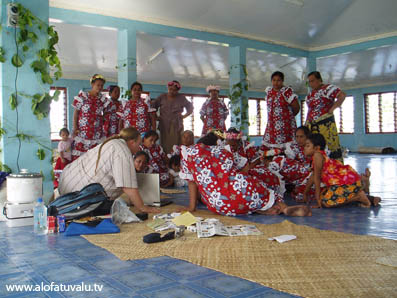
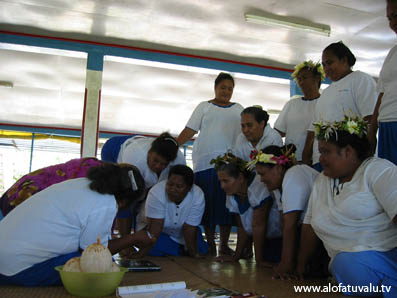
Consultation meetings were organized with 9 women’s groups (300 women), which were very positive - committing support to biogas technology, offering community owned land to site the plants and enthusiastically agreeing to be trained to use and maintain the equipment.
Following our first draft presentation, the government of Tuvalu, in the name of its Minister of Energy and Transportation, officially asked Alofa Tuvalu to pursue its work. In parallel, a contract was signed with TMTI, Tuvalu Maritime Training Institute, to implement a micro model on Amatuku. In March 2006, the study and the Amatuku micro-model project were presented to Cabinet and discussed at parliament.
Furthermore, meetings with 200 Tuvaluan copra producers demonstrated overwhelming support and showed economical commitment for revitalizing copra market via biodiesel production.
FOR FULL STUDY please contact us

The 1st edition of the "Tuvalu Cultural King Tides festival" -Tuvalu E! The Tide is High!- took place in Funafuti-TUVALU, from Feb 26th to March 1st, 2010.
During 2 days, traditional competitions and demonstrations showed some aspects of Tuvaluan Culture through sports, handicrafts, dancing, singing, food and Tuvalu’s unique talent in improvised story-telling and dramas. The objective was to raise awareness about what will be lost if Tuvalu’s nation was to disappear. Parallel activities on climate targeted both children and adults, focusing on what we all can do to try to turn the tide.
This first edition was made possible by the unified efforts of many Government ministries and NGO’s. It is part of The “Small is Beautiful” (SIB) plan, one of UNESCO’s Decade of Education for Sustainable Development Remarkable Actions, launched with, as a primary objective, the preservation of Tuvalu’s cultural heritage and identity.
Day 1 on 
Day 2 on

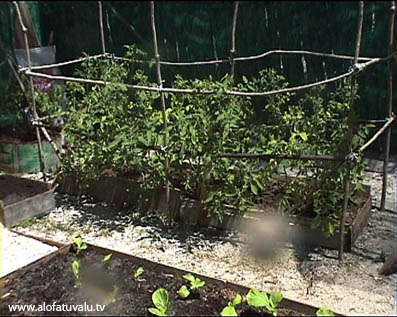
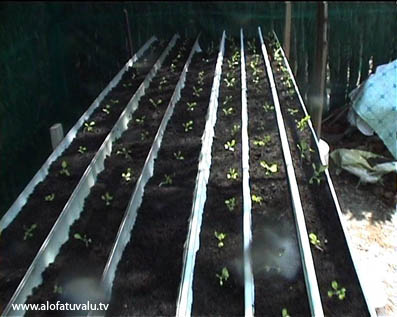
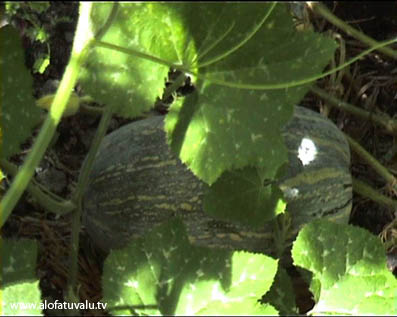
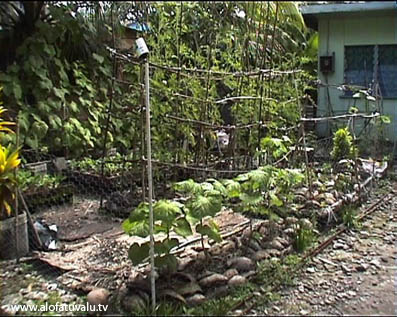
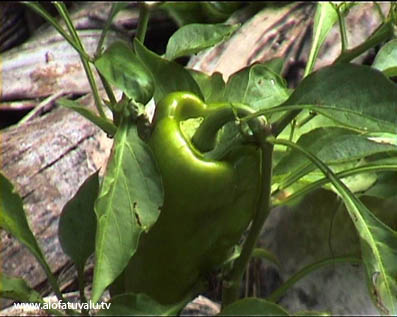
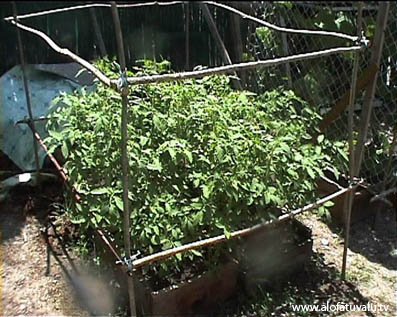
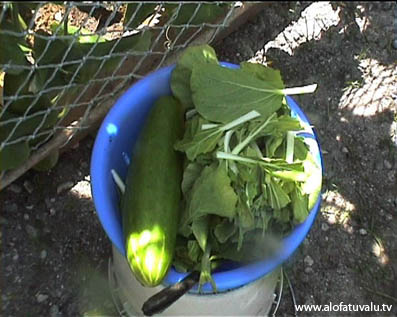
- Regular organic seeds handing out and awareness raising about gardening, compost, biogas :
Watch 2006, Organic seeds distribution, on YouTube
Watch 2006, 3 Community meetings on biogas, on YouTube
  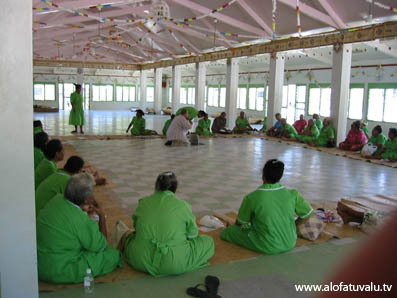

Giving back to the people the pictures we take has become a tradition since Trouble in Paradise, shot in 2003.
Each participant received a copy of the film the following year.
Over the years almost everything has been filmed with what has become Alofa Tuvalu’s 3rd eye - the video camera. All steps of Alofa Tuvalu’s work are systematically covered as well as ceremonies and cultural activities.
As a result Alofa Tuvalu team is often treated as « members of the family », camera and all.
Each year, Alofa Tuvalu gives back the pictures it took during its traditional pictures exhibition
at the Vaiaku Lagi Hotel and videos are handed out to concerned people.
Trouble in Paradise is the only commercial film of the present collection.
Alofa Tuvalu activities video are available on . All others were made for our Tuvaluan friends only.
|
|
|
|
2004 |
|
|
 Teaser on Teaser on 
|
2005 |
|
|
|
|
Supports to the Alofa Tuvalu Small is Beautiful plan |
Small is Beautiful Survey trip
in Amatuku - |
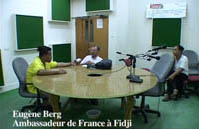
Ambassabird : visit of French Ambassador Eugene Berg |
|
|
|
|
|
Farewell Tetele, summer 2005 |
Kalisi’s mum ceremony |
Lina’s husband’s birthday |
2006 |
|
|
|
|
Alofa Tuvalu community
meetings on biogas - |
Alofa Tuvalu organic
seeds distributions - |
King Tides, february 2006 |
|
|
|
|
|
Elections 2006 – Vaitupu party
in honor of the new Prime Minister, Apisai Ielemia |
Elections 2006 - Swearing |
Tuvalu Independance Day |
|
|
|
|
|
EKT General Secretary Farewell |
Emma’s wedding |
|
2007 |
|
|
|
|
Alofa Tuvalu survey trip and staff meetings on biogas |
Anemometer implementation by Alpha wind energy (Dk) |
Environment day 2007 |
|
|
|
|
|
Red Cross cleaning day |
Gaby live at Vaiaku Lagi hotel |
Kids singing in tree |
|
|
|
|
| |
Gilliane's birthday at the Alofa Tuvalu ocean side house |
Eti’s barbecue |
Taiwanese demo cooking |
|
|
|
|
|
Fiafia nights |
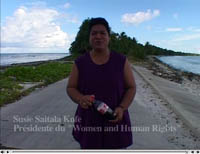
One day in the life of Susie |
Wedding Party |
|
|
|
|
|
Filipo’s Funerals |
Yvette’s daughter’s first birthday |
France - Climate parade, Paris |
2008 |
|
|
|
|
Alofa Tuvalu Gasification demos 2008 - |
Alofa Tuvalu Biodiesel and Ethanol demos 2008
|
Tuvalu Red Cross induction workshops in Funafala
(Part 1) |
|
|
|
|
| |
Tuvalu Red Cross induction workshops in Funafala
(Part 2 - Quiz) |
Tuvalu Red Cross induction workshops in Funafala
(Part 3) |
Reception at the PM residence with the Vaitupu children,
april 2008 |
| |
 |
|
|
|
Dina and Tevave’s girls 1st birthday, june 2008 |
|
|
2009 |
|
|
|
|
Alofa Tuvalu Biogas training 2006-2009 - |
Alofa Tuvalu Biodiesel and Gasification workshops 2009 |
Alofa Tuvalu
Waste Fashion Show |
|
|
|
|
|
Earth hour in Tuvalu 2009 |
Environment day 2009 |
King Tides 2006, edited again for Tuvalu PM press conference at COP15
|
|
|
|
|
|
|
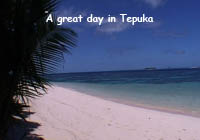
Picnic at Tepuka
with Nala and Apisai
|
|
2010
2011 |
|
|
|
|
|
|
|
|
|
|
|
|
|
|
|
|
|
|
|
|
|
|
|
|
|
|
|
|
|
|
|
|
|
|
|
|
|
|
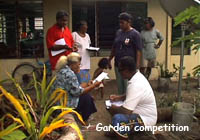
Garden Competition |
| |
 |
 |
|
| |
IRWM Water quiz |
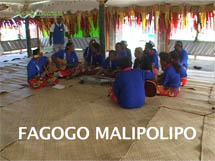
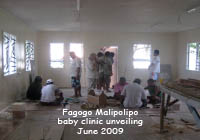
Fagogo Malipolipo, Baby clinic unveiling, June 2009 |
|
|
|
Editing in progress:
- Fagogo Malipolipo singing
for prisoners
- FM singing at the hospital
- FM Christmas Party
- Nanumea Women Meeting and donation to the community
- TMTI passing out at Amatuku
- Tinapolo's farewell.... |
|
|
“We wish you”
|
|
|
| |
|
|
|

« 100 things one can do to help Tuvalu... And YOU… »
These short programs are part of Alofa Tuvalu’s main project « Small is Beautiful » made possible by the French Energy Agency, ADEME, PIGGAREP, The Taiwanese Embassy in Funafuti and many organisations and individuals all over the world, and obviously in Tuvalu..
Since 2007 this three-month daily series aims at helping Tuvaluans be more pro active for their future by sharing experiences. They are launched each year during International Environment Day (or month !) celebrated in many countries. The Alofa Tuvalu radio program is made with the people for the people. Tuvaluans share their experiences, what they are doing to » kick the habit » of consuming fuel from reducing their electricity or gas expenses, to organic gardening with compost… The series will go on in 2009.
Reducing our emissions has a positive impact on our atmosphere, it also helps save money and reduce oil imports.

Over the years almost everything implemented has been filmed with what has become Alofa Tuvalu’s 3rd eye -- the video camera. All steps of Alofa Tuvalu’s work are systematically covered as well as ceremonies and cultural activities. Each year, Alofa Tuvalu gives back the pictures it took during its Traditional pictures exhibitions at the Vaiaku Hotel and videos are distributed to the people.

Late 2004, during the « Small is Beautiful » presentation trip to Tuvaluan people, Gilliane Le Gallic, Trouble in Paradise co-director, and Laure Noualhat, journalist of the daily newspaper Liberation, set up the Tuvalu International Francophone Press Club, with the support of the International Francophone Press Union and Tuvalu Media Corporation.
|